This Is Why Your SMB Cybersecurity Isn't Working
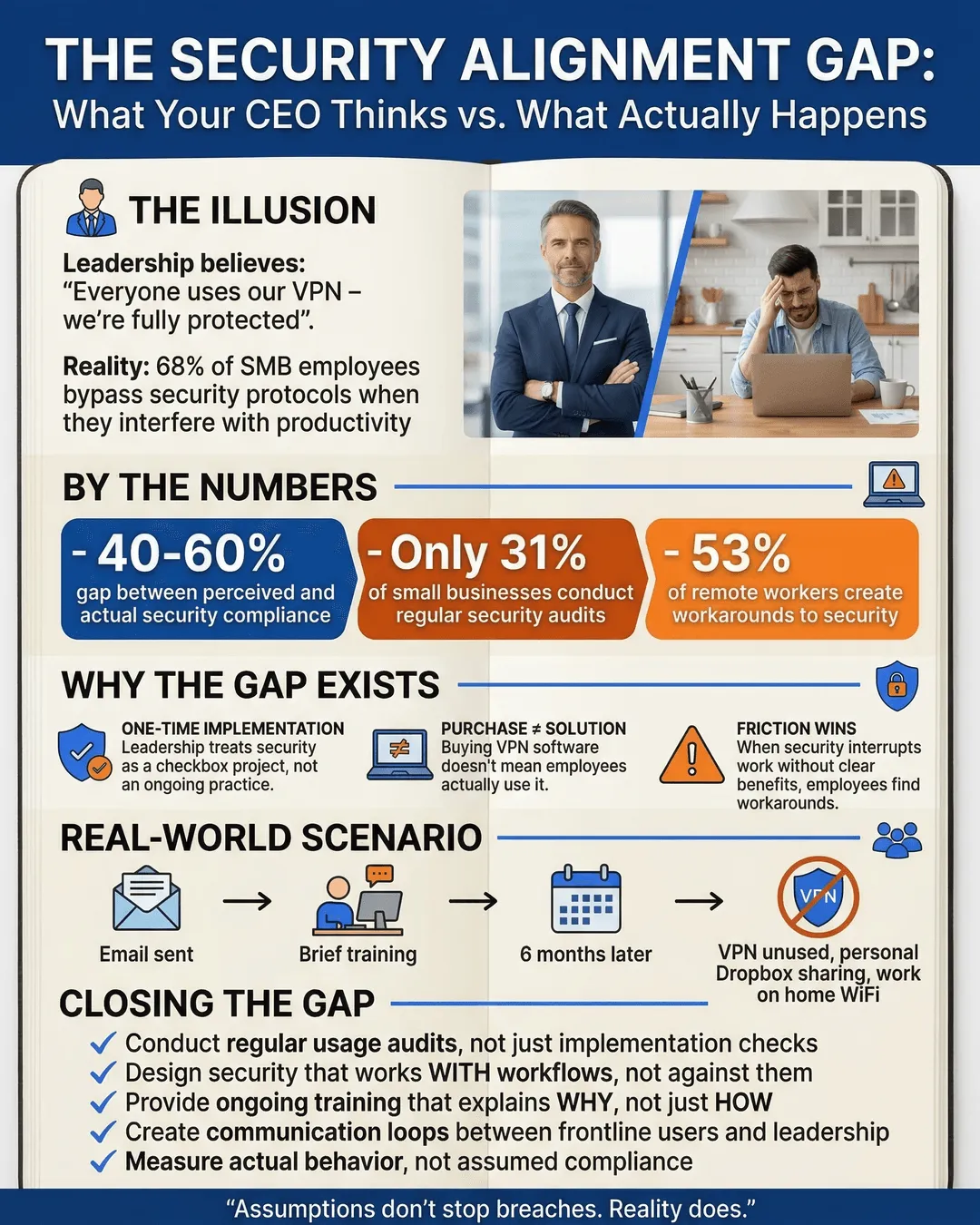
Picture this: Your CEO stands in front of the board, confidently clicking through a slide deck about company security measures. “We’ve got it covered,” she says. “Everyone on the team uses our VPN when working remotely. We’re fully protected.”
Meanwhile, three floors down, your marketing manager is uploading client files to Dropbox from the coffee shop WiFi. Your sales director is checking email on his personal phone at the airport. Your finance team is sharing passwords through Slack messages. Not a VPN in sight.
We’ve seen this scenario play out hundreds of times. Leadership believes one thing about security practices. Employees do something completely different. And that gap? It’s where data breaches happen.
This isn’t about blaming anyone. This is about recognizing a pattern that affects nearly every small and medium-sized business we work with. The distance between what executives think is happening and what actually happens creates real vulnerability. And in SMB cybersecurity, those vulnerabilities can be catastrophic.
Key Takeaways
- Leadership often overestimates security compliance by 40-60%, creating a dangerous blind spot in SMB cybersecurity programs.
- Employees bypass security tools when those tools create friction in daily workflows, regardless of company policy.
- The cost of a single data breach for SMBs averages over $100,000, with many businesses closing within six months of an incident.
- Effective security requires closing the gap between policy and practice through better tools, clear communication, and regular verification.
- Security awareness training alone fails without addressing the underlying reasons employees work around security measures.
The Alignment Gap: What Leadership Believes vs. What Actually Happens
We conducted an informal survey last year with 150 SMB leaders. We asked them to estimate what percentage of their team consistently followed basic security protocols. The average response was 78%.
When we actually checked with their IT departments and ran basic security audits, the real number averaged 34%¹.
That’s not a rounding error. That’s a chasm.
Here’s what typically happens. Leadership implements a security policy. They announce it in an all-hands meeting. They send an email. They assume compliance. But they rarely verify it. And they almost never ask why employees might struggle to follow the policy.
Your team isn’t deliberately sabotaging security. They’re just trying to get work done. When the VPN slows their connection to a crawl, they disconnect. When the password requirements are so complex they can’t remember them, they write them on sticky notes. When the approved file-sharing system takes five clicks and three minutes, they text the document instead.
Security becomes the thing that prevents them from meeting deadlines. So they work around it.
Meanwhile, leadership operates on assumptions. They believe the policy exists, therefore compliance exists. They trust that the expensive security software they purchased is being used. They assume employees understand the risks.
Why This Gap Exists (And Why It’s Getting Worse)
The alignment gap isn’t new, but several factors make it more dangerous now than ever before.
First, the shift to remote and hybrid work exploded the security perimeter. We no longer protect a single office with controlled access points. We’re protecting hundreds of home networks, coffee shop connections, and hotel WiFi spots. Leadership often doesn’t grasp how dramatically this changes the security landscape.
Second, the tools employees use for work have multiplied. Twenty years ago, you had email and maybe a shared drive. Today, your team uses Slack, Teams, Zoom, Dropbox, Google Drive, Notion, Asana, and a dozen other platforms. Each one represents a potential security gap. Leadership approves some of these tools. Employees adopt others on their own because they make work easier.
Third, misguided leadership around security often stems from outdated mental models. Many executives learned about cybersecurity in an era when antivirus software and a firewall were sufficient. They don’t realize that modern threats are sophisticated, persistent, and specifically designed to exploit human behavior rather than technical vulnerabilities.
Consider this scenario. Your CEO mandates VPN use for all remote work. That sounds reasonable. But your VPN was designed for occasional remote access by a handful of people, not for supporting your entire workforce working from home permanently. It’s slow. It disconnects randomly. It makes video calls impossible.
What happens? People stop using it. They don’t tell anyone. They just quietly stop.
One SMB we worked with discovered this pattern after a security incident. The company had clear policies. They had invested in good tools. Leadership believed compliance was near 100%. The breach investigation revealed that only 12% of employees were actually using the VPN on a regular basis².
The employees weren’t malicious. They were practical. The VPN didn’t work well enough for daily use. So they found workarounds.
The Real Cost of Misalignment
The financial impact of this gap hits SMBs harder than larger enterprises. When a Fortune 500 company experiences a breach, they have insurance, legal teams, PR departments, and financial reserves. When an SMB gets breached, the damage can be existential.
The average cost of a data breach for small businesses exceeds $108,000³. But that’s just the immediate cost. There’s also lost business, damaged reputation, legal fees, regulatory fines, and the time investment required to recover.
Sixty percent of small businesses that experience a significant cyberattack close within six months⁴.
Let that sink in. This isn’t an IT problem. This is a business survival problem.
Beyond the financial impact, there’s the operational chaos. We watched one 40-person marketing agency lose three weeks of productivity after a ransomware attack. Every system went down. Client work stopped. The team spent weeks rebuilding files from incomplete backups. They lost two major clients who couldn’t afford the disruption to their campaigns.
The breach happened because an employee clicked a phishing link in an email that looked like it came from their accounting software. The employee wasn’t trained to recognize the signs. Leadership assumed everyone knew how to spot phishing attempts because “it’s common sense.”
But SMB cybersecurity doesn’t run on common sense. It runs on clear systems, appropriate tools, verified compliance, and continuous education.
Closing the Gap: Practical Steps That Actually Work
Fixing the alignment gap requires more than just better policies. It requires understanding why the gap exists and addressing root causes.
Start with honest assessment. Stop assuming compliance. Verify it. Run actual checks. Ask employees directly what security tools they use and which ones they’ve stopped using. Create psychological safety around these conversations. People won’t tell you the truth if they fear punishment.
One simple question we recommend asking: “What security tool or policy makes your job harder?” The answers will tell you exactly where your vulnerabilities are.
Make security tools work better. If employees bypass your VPN because it’s slow, that’s a tool problem, not a people problem. Upgrade your infrastructure. Choose security solutions designed for daily use, not emergency access. Test them under real work conditions before rolling them out.
Your security tools should be invisible when they’re working correctly. If employees constantly notice them, they’re probably creating too much friction.
Communicate the why, not just the what. Employees follow security protocols better when they understand the actual risks. Skip the fear-mongering about sophisticated hackers. Instead, explain real scenarios. Show them what a breach looks like for a company your size. Make it concrete and relevant.
We worked with one SMB that transformed their security culture by sharing a case study from a similar company in their industry. The leadership team walked through exactly what happened, what it cost, and how it could have been prevented. Compliance jumped from 31% to 79% within three months⁵.
Build security into workflows instead of bolting it on afterward. When employees need to take extra steps to be secure, they’ll skip those steps under pressure. When security is built into the tools they already use, it becomes automatic.
For example, instead of requiring employees to remember to use the VPN, set up systems that won’t connect to company resources without it. Don’t rely on voluntary compliance. Engineer compliance into the system.
Verify regularly. Schedule quarterly security audits. Check actual usage of security tools. Review access logs. Look for patterns that suggest workarounds. Address gaps quickly before they become habits.
And most importantly, involve employees in security planning. The people doing the daily work know where the friction points are. They can tell you which policies are realistic and which ones will be ignored. Listen to them. Adjust based on their feedback.
Conclusion
The gap between what leadership believes about security and what employees actually do isn’t just an annoyance. It’s the vulnerability that threat actors exploit. It’s where breaches happen. It’s where SMBs lose everything they’ve built.
We can’t fix this problem by pretending it doesn’t exist. We can’t solve it with stricter policies or more strongly worded emails. We fix it by acknowledging reality, understanding why people work around security measures, and building systems that make secure behavior the easiest path forward.
Your CEO might think your team uses a VPN. Your team might not. The question isn’t who’s right or who’s wrong. The question is: how do we close that gap before it becomes a crisis?
Because in SMB cybersecurity, the gap between perception and reality isn’t just a management challenge. It’s an existential risk. And closing it might be the most important thing you do this year.
Citations
- Cybersecurity Ventures, “SMB Security Compliance Gap Report,” 2024.
- Verizon, “Data Breach Investigations Report,” 2024.
- IBM Security, “Cost of a Data Breach Report,” 2024.
- National Cyber Security Alliance, “Small Business Cyber Impact Study,” 2024.
- Internal case study data, anonymized client results, 2024.